Why Our CMS Is the Right Choice for Your Business Website
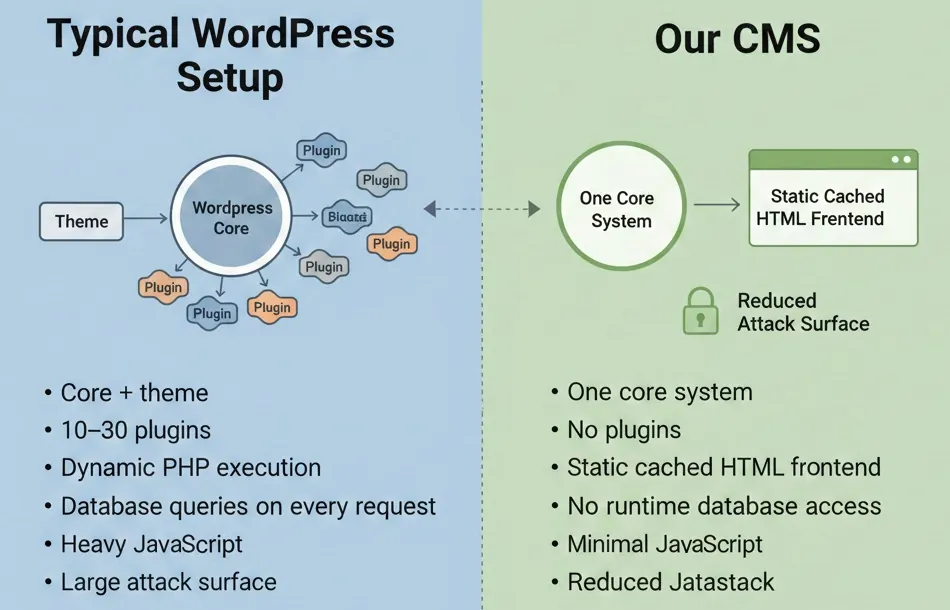
At Jademond, we built a CMS specifically designed to solve the common problems of traditional platforms like WordPress — slow speeds, security risks, and constant plugin dependencies. Our solution focuses on what truly matters for businesses: fast loading times, robust security, and SEO-first architecture. No gimmicks, just a CMS built for the long-term success of your website.
Let's Solve Your Problems Together
WordPress: Bloat and Security Risks
WordPress’s reliance on third-party plugins leads to performance bloat, negatively impacting SEO through slower page loads and Core Web Vitals issues. Its plugin ecosystem also introduces security vulnerabilities, as outdated or poorly coded plugins are common entry points for hackers. Additionally, technical SEO challenges like duplicate content and improper redirects require extensive manual optimization. Sources: Ahrefs, SucuriWix: SEO Restrictions and Slow Performance
Wix limits SEO control by restricting access to robots.txt, schema markup, and other advanced features. Its heavy use of JavaScript results in slow page loads, especially on mobile, affecting Core Web Vitals and SEO rankings. This lack of flexibility can hinder businesses from fully optimizing their websites. Sources: Web OracleSquarespace: SEO Limitations and Performance Issues
Squarespace offers limited SEO customization, making it difficult to manage meta tags or implement structured data. Its media-heavy templates and built-in animations result in slow loading times, negatively impacting SEO rankings and mobile performance. Sources: RedditJoomla: Extension Bloat and Security Risks
Joomla’s reliance on third-party extensions for SEO and functionality leads to performance bloat and SEO issues if not properly managed. Its complex update system also leaves sites vulnerable to security risks from outdated or insecure extensions, requiring careful oversight to avoid breaches. Sources: HackertargetDrupal: Complexity and Security Overhead
Drupal is powerful but comes with complexity that can lead to SEO issues due to its steep learning curve and the need for third-party modules to handle basic SEO tasks. Its reliance on custom modules can cause performance bloat and make sites slower. Security vulnerabilities are common when modules aren't kept up-to-date, and manual updates often require technical expertise, making it harder to maintain without specialized knowledge. Sources: DrupalOur Approach: Built for Speed, Security, and SEO
Most CMS platforms try to solve every possible use case. We deliberately did the opposite.This CMS was built with three non-negotiable pillars in mind: SEO, speed, and security — nothing more, nothing less.

Let's Solve Your Problems Together
SEO-First Architecture
Unlike traditional systems that rely on plugins to “fix” SEO later, our CMS is SEO-first by design.- Clean, semantic HTML output without unnecessary wrappers or div soup
- Strict headline hierarchy (H1–H6) enforced by the module system
- Full control over URLs, including flexible structures and manual overrides
- Built-in redirect management for clean migrations and long-term SEO stability
- Native handling of title tags, meta descriptions, canonicals, ...
- Search-engine aware by default — optimized for Google and Baidu
- SEO is not an add-on. It’s part of the core architecture.
Speed by Reduction, Not Optimization
Speed is achieved by removing complexity, not compensating for it.- Lean, minimal HTML output without framework overhead
- No JavaScript frameworks unless absolutely required
- No database queries on page view
- Extremely fast load times
- Excellent Core Web Vitals
- Consistent performance under traffic spikes
Security by Architecture
Instead of reacting to threats, this CMS reduces them by design.- Backend runs on a separate, non-public domain, making it harder to discover and attack
- Frontend does not execute PHP and does not access a database
- Minimal external dependencies reduce the overall attack surface
- No public plugin ecosystem to exploit
- Controlled updates handled centrally, not by end users
Modular, Controlled, Maintainable
The system follows a strict modular architecture:- Design modules are self-contained and reusable
- Content is structured, not free-form
- Module code is centrally maintained — updates improve all pages instantly
- No WYSIWYG editors, no broken layouts, no unpredictable markup
Let's Solve Your Problems Together